


In the spirit of Phil Gilbert’s “Irresistible Change” release, and my short review of it last week, I’ve been motivated to share some more on the subject of change management.
Phil Gilbert's "Irresistible Change"

Phil Gilbert has published a new book - Irresistible Change - and this week I want to focus on key messages we can pull from it.
In particular, there are failure modes to managing change that we all need to look out for. In a previous post on collective wisdom, I mentioned the bus-brake effect in passing:
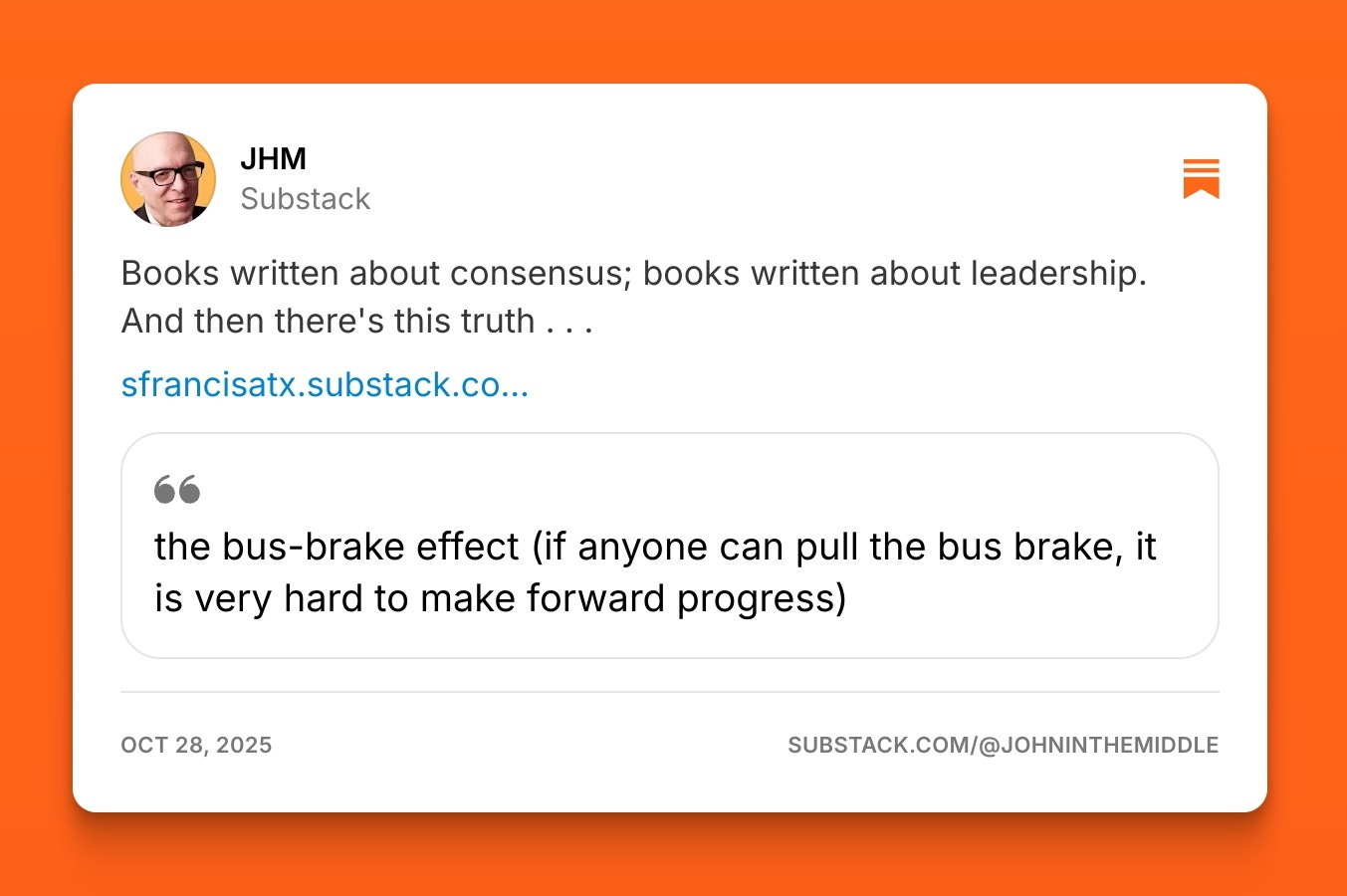
And since JHM pointed it out, I feel compelled to share a bit more about it. Years ago I wrote about six failure modes for managing change.
What is the Bus-Brake Effect?
The Bus-Brake Effect is one of those failure modes: anyone can pull the bus-brake, and then everyone has to stop. It’s incredibly inefficient.
We’ve all ridden a city bus at some point. Most bus systems have a bus-brake that you pull if you want to be let off at the curb in-between stops, or at the next official stop. This can be infuriating when you’re trying to travel through, of course. And it turns out that anyone can pull the bus-brake – any passenger at all, even the kid who is just having fun with it and pulling it periodically to irritate other passengers. Making progress on the route depends on everyone on the bus withholding, voluntarily, their right to pull the bus-brake.
In my experience rolling out product configuration and sales process software in the 90’s, and in rolling out business process solutions in the 2000’s and 2010’s, and AI-oriented solutions in the 2020’s - these barriers to progress are common across technology movements because they’re really about the human condition, not about the changes you want to implement.
How does the Bus-Brake Effect Manifest?
The Bus-Brake Effect can be an approval from a stakeholder, a budget approval, or a person who feels they are protecting their team or function or fiefdom from your changes. Often it comes in the form of disrupting your progress meetings or progress reports. You have an agenda and they raise surprise objections that were not on the agenda and undermine your efforts to keep the group focused. You have to lead assertively in these situations.
Many attempts to change - to roll out new ways of doing things - suffer from the bus-brake problem. In Austin, Texas, voters approved a passenger rail system in a popular vote by an overwhelming margin. And yet, there are people taking the city to court to stop it - not to change it, alter it, or improve it, but to stop it cold. They’re attempting to pull the bus-brake. The City Council initiated a reconstruction of the Austin Convention Center, an important pillar of our local event economy. The old convention center has been razed, and only now, the bus-brake people are suing the City to stop the construction of a new Convention Center (which would have the effect of leaving a pit of rubble in the ground for decades).
Arguably our court system is one that should have the power to pull the bus-brake as a check on the other branches of government at various levels. However, I would argue that they should use more discretion to determine when lawsuits are spurious attempts to stop progress or genuine issues of public interest.
And in your change programs and projects, you’ll experience the same issues. Some people will pull the brake for good reasons - that must be addressed. Some are simply trying to halt progress or stop someone else’s success.
Governance introduces people who can pull the Bus-Brake
Effectively, most governance structures give nearly everyone a veto and no one an override to continue making progress.
Think about who can pull the bus brake on your project:
Business subject matter experts
Business unit managers or team leads
IT managers
Security
Compliance
Project Management Office
Legal or Risk
Finance or budgets
IT integration developers
DB administrators
IT Infrastructure team (servers etc. )
Users
Your own project or change management team members
Technology or change management initiatives that cross organizational boundaries are particularly susceptible to the bus-brake effect because they need approval not just from each functional silo, but also from each business unit silo. You’ll hear that “it needs a security audit”, that it might need a compliance review, that John who runs one of the affected business units hasn’t signed off, etc.
It is very important for the leader of a change program to set the tone that these governance structures are not in place to stop forward progress - that their job is to inform and advise; and when necessary, show how to overcome obstacles. Get that framing set early and often.
Seven Tactics to get the Bus Moving Again
So if everyone can pull the brake, how do we make progress? Here are seven tactics to help you move your organization forward. Judicial use of these tactics and others will get you to the finish line!
You have to do the work to build alignment for those who truly hold a veto. Try to get them to agree to let go of future veto rights on what you’re doing, to the extent possible. I’ve found design workshops to be incredible tools for doing just this. The ice breakers, brainstorming, dot-voting, and executive decision-making helps build a great consensus for the desired change effort. Alignment isn’t just objective, it is also emotional and cultural, and you need to address those elements of alignment as well.
Don’t give veto rights to anyone who doesn’t legitimately have them. We want input, not vetoes. We often implicitly give someone a veto when they have an objection, though they don’t literally have the power to stop your program. Always engage with objections with the implicit assumption that forward progress continues, while you will entertain constructive input and improvement from that person or the group they represent. “I want to understand that perspective better, let’s set up time to discuss it.”
Default mode is to move forward with the plan. Set a time frame for resolving any objection that slows or stops progress. It has a time-boxed effort to get to resolution, otherwise we default back to continuing as planned - removing the default of “no change” from the table.
Find a way to YES. For those that have objections (legal, compliance, etc.) you task them with the goal of finding a way to yes. In other words, the answer is yes, how do we do that the right way. (not, as is often the case, the answer is “no” because that minimizes risk for them). At Shopify, a big unlock for adopting AI was to tell the lawyers that they needed to say “yes” by default and work on “how” - rather than the typical legal stance of “no” being the default. This doesn’t just apply to legal concerns - but many other risk-averse blockers.
“If you don’t default to ‘yes,’ you’re defaulting to ‘no,’” says Thawar. “If left undefined, which is what most companies do, that’s basically a ‘no.’” — from FirstRound’s blog
Have a plan B if a team (team member) critical to your success pulls the brake. Can you work around them, do you have an alternate path? Do you have a strategy to win them over?
Give everyone a positive stake in the change - what can they look forward to on the other side of this initiative. This isn’t always possible but it sure helps if you can get it done.
Ultimately, you have to show leadership. That means standing up to people with respect, it means persuading people to your point of view, and it means using your authority when you must, and earning approvals when you must. None of these tactics work without leadership!
You’ll need a bunch of tools in the utility belt to fight off the bus-brake effect. Using them effectively and early in the process will dissuade people from pulling that brake unnecessarily. Treating serious issues seriously will also earn you points, and treating unserious issues accordingly but with respect, also will earn you points with your team.
Hopefully this post has sparked some ideas for identifying the bus-brake effect early and preventing it from stalling your change initiative!
One more Thing…
There’s a great interview (actually there are several really good interviews) with Farhan Thawar of Shopify. He’s got some fantastically contrarian takes on certain issues, and communicates his ideas with a level of excitement that is really infectious.
This link picks up at the beginning of a discussion on enabling AI adoption - but after watching it, rewind and watch the whole thing. The previous discussion for example touched on great topics like “will AI vibe-coding kill SaaS software?” and will non-coders write code with AI?
It’s a great discussion. Anytime you have a chance to see Farhan speak, you should run not walk to the session. I had the good fortune of working with him many years ago here in Austin, and his personality comes through the same way in writing, in person, on stage - he just is who he is and you get that unfiltered, fast-thinking, fast-talking barrage every time.